
Virginia · Reviewed 2026-10-24
Virginia journal requirements & evidence
Keep the act, principal, identification and fee together, then export a readable copy when needed. The specimens here use fictional Virginia records and the app’s actual journal export.
The July 1, 2026 change
Traditional notaries now need a record of each act as well. Keep records of nonelectronic acts performed on or after July 1, 2026 for at least five years from the transaction. Electronic-act records also have a five-year minimum. Electronic notaries have additional backup, control and, where applicable, recording duties.
Virginia Code § 47.1-14(C)–(D)6 sample checks passed · Three app exports and three visible-PDF checks
These checks cover synthetic export specimens. Long-term retention, lawful access and remote-session duties remain ongoing responsibilities.
VA-J01A complete record for each actExport sample verified
Traditional and electronic acts
Record the act time, act and document, principal name/address, identity basis and any fee.
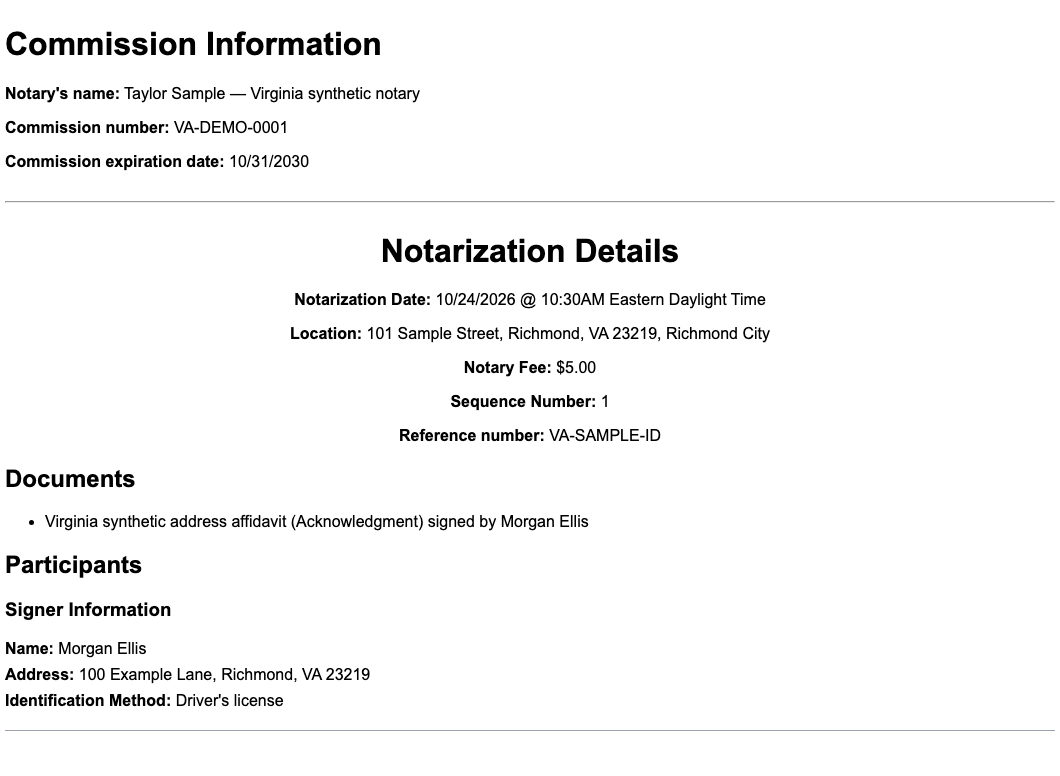
§ 47.1-14(C)Evidence and workflow: The app’s journal export preserves these fields together. The credential specimen shows a Richmond acknowledgment, its principal and address, the identification type, a time with its zone and a $5.00 fee.
VA-J02Record how identity was establishedExport sample verified
Traditional and electronic acts
Record personal knowledge or the identification type; include required credible-witness details when that method is used.
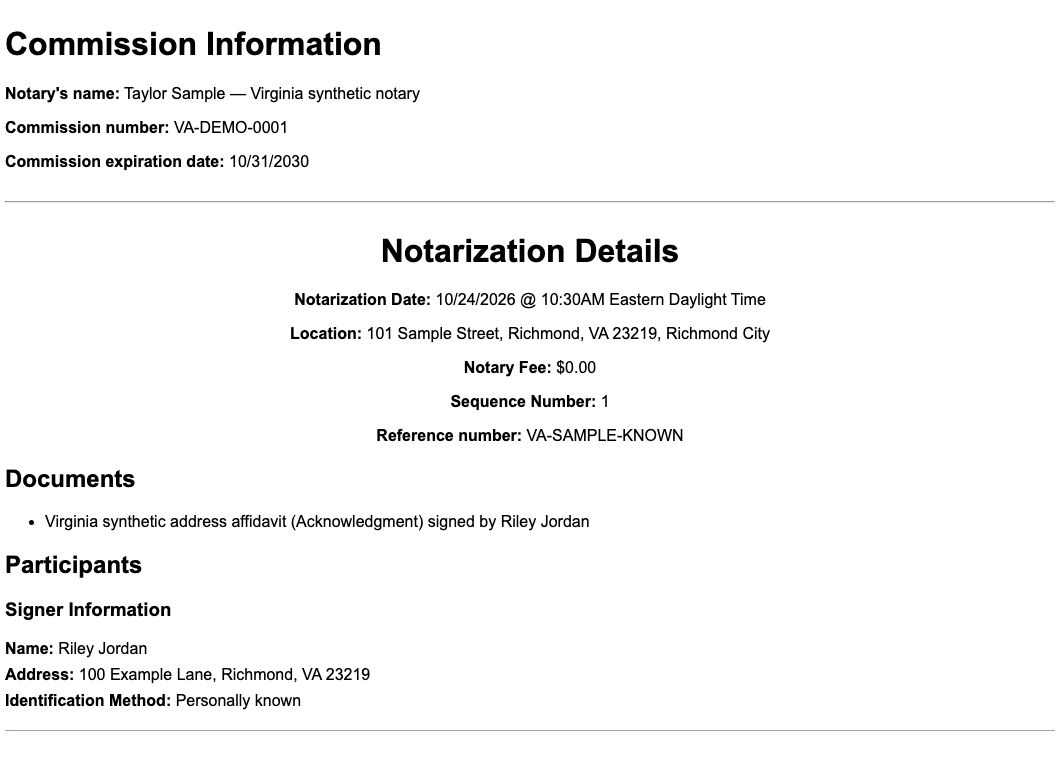
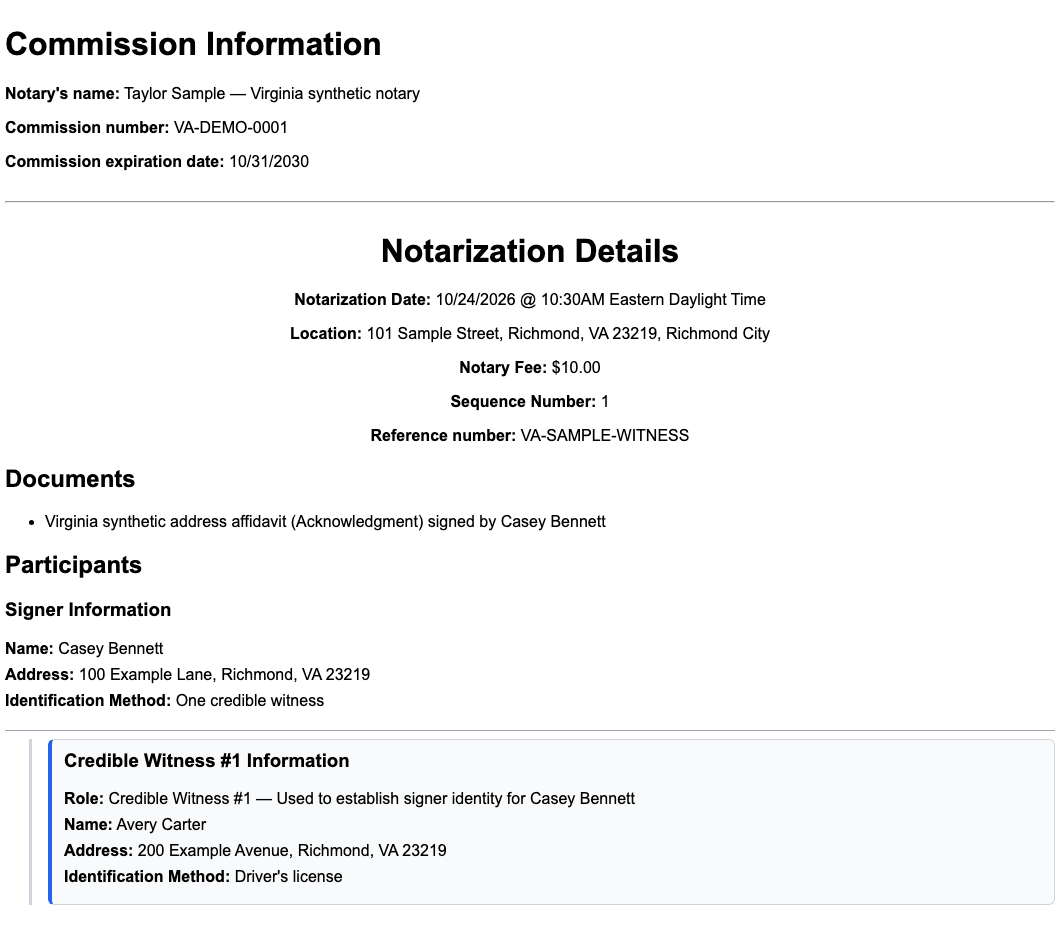
§ 47.1-14(B)–(C)Evidence and workflow: Separate exports show personal knowledge with no fee, and a credible witness with a printed name, address and identification type. These are distinct identity examples, not interchangeable procedures.
VA-J03Provide records for lawful inspectionExport sample verified
Traditional and electronic acts
Keep the journal available for lawful inspection.
§ 47.1-14(C)Evidence and workflow: Printable exports provide readable entries and separate downloadable PDFs. The notary determines whether a request is lawful and arranges access in accordance with Virginia law.
VA-J04Preserve records for at least five yearsOngoing responsibility
Traditional acts from July 1, 2026; electronic acts
Retain applicable records for at least five years from the transaction.
§ 47.1-14(D)Evidence and workflow: Keep an independent journal copy and a retention schedule measured from each transaction. A fresh export demonstrates portability; it cannot demonstrate that five years have elapsed.
VA-J05Protect the electronic journal and its backupOngoing responsibility
Electronic notarial acts
Protect integrity, maintain a backup and keep the record secure under the electronic notary’s exclusive control.
§ 47.1-14(C), (F)Evidence and workflow: Use the journal’s record-integrity and backup controls and protect downloaded copies. Review account access and storage arrangements for the electronic notary’s own records. This export review does not measure production storage or operator access.
VA-J06Retain remote-session evidence when requiredRemote-session duty
Remote electronic notarization
When conference technology is the identity basis specified by the statute, retain the recording and identify any other identification used.
§ 47.1-14(C)Evidence and workflow: Keep the audio/video recording connected to the corresponding journal act and protect it for the applicable retention period. The traditional-act specimens here are not remote-session recordings.
VA-J07Keep signature devices current and report compromiseOngoing responsibility
Electronic notarial acts
Keep electronic-signature devices current, secure signature/seal control and report loss or possible unauthorized use as required.
§ 47.1-14(E)–(H)Evidence and workflow: Check certificate/device status and keep a documented incident contact procedure. Promptly notify the Secretary in the commissioned name; report theft or vandalism to the appropriate law-enforcement agency. These are ongoing notary duties.
Journal software and electronic-notary authorization
Using an e-journal does not commission an electronic notary or authorize remote notarization. Virginia’s application requires the notary’s technology description and certification of compliance with its standards. A completed sample record is not a government approval of a vendor.
Virginia electronic-notary application requirements